Freestyle Stroke Basics for Adult Beginners
Break down the most common swimming stroke into learnable pieces
Freestyle — also called front crawl — is the stroke you see most often in pools. It's the fastest and most efficient stroke, and it's the one most adult beginners want to learn first. Here's how to build it from the ground up.
What You'll Need
- Ability to float, kick, and breathe with face in water (complete earlier guides first)
- A kickboard for drill work
- Goggles
- A lane or open space
Step-by-Step Guide
Master your kick first
Freestyle kick is a flutter kick — alternating up-and-down leg movements originating from the hip. Hold a kickboard and kick across the pool. Your legs should be mostly straight with relaxed, pointed ankles.
Tip: The kick in freestyle is mostly for balance and body position, not propulsion. Don't exhaust yourself trying to kick hard — focus on keeping your legs near the surface.
Learn the arm pull pattern
Standing in the water, practice the arm motion. Reach forward, enter the water with your fingertips angled down, pull through the water alongside your body, exit at your hip, recover over the water back to the front. This is one complete arm cycle.
Tip: Your hand should enter the water in front of your shoulder — not across your centerline (which causes snaking) and not too wide (which reduces efficiency).
Practice catch-up drill
Swim with one arm extended in front while the other arm completes its full pull cycle. The moving arm 'catches up' to the stationary arm before the next stroke begins. This slows the stroke down and lets you focus on each phase.
Tip: This drill feels slow and awkward at first. That's the point — it forces you to feel each part of the stroke separately before combining them.
Add body rotation
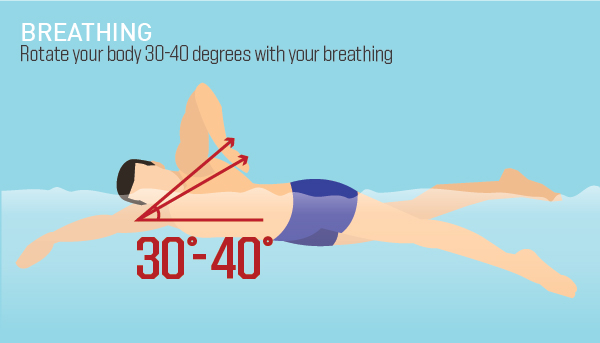
Freestyle is not a flat stroke — your body rotates side to side with each arm pull. As your right arm pulls, your body rotates right. As your left arm pulls, your body rotates left. This rotation is what generates power and makes breathing possible.
Tip: Think of your body as a log rolling in the water, not a flat plank. The rotation should feel like it's coming from your core, not just your shoulders.
Integrate breathing
As your right arm pulls through, rotate your head right and inhale. As your arm recovers, rotate your head back down and exhale. Aim for every 3 strokes (alternating sides) once you're comfortable.
Tip: See the full breathing guide for detailed technique. Breathing is the hardest part of freestyle for most adults — give it dedicated practice time.
Swim full lengths
Now put it all together. Swim one full length of the pool focusing on smooth, consistent technique. Rest. Swim again. Gradually reduce your rest intervals as your fitness improves.
Tip: Count your strokes per length. As your technique improves, your stroke count will decrease — you'll cover more distance with each pull. This is a concrete measure of efficiency improvement.
Common Mistakes (and How to Fix Them)
Crossing the centerline with your hand entry
Enter the water in front of your shoulder, not across your nose. Crossing the centerline causes your body to snake side to side, wasting energy.
Dropping your elbow during the pull
Keep your elbow high during the pull phase — this is called 'high elbow catch' and it's what makes the pull powerful. A dropped elbow pushes water down instead of back.
Not rotating your body
Flat freestyle is inefficient and hard on your shoulders. Practice the rotation drill (one arm extended, rotate your body fully to each side) to build the habit.
Kicking too hard
In recreational freestyle, a 2-beat kick (2 kicks per arm cycle) is sufficient. Save your legs — they're less efficient than your arms and will exhaust you if overused.
Your Practice Schedule
Spend 10 minutes per session on drills (catch-up drill, kick with board, one-arm drill) before attempting full freestyle. Drill work builds the neural pathways that make the full stroke feel automatic. Don't skip the drills to get to 'real' swimming faster — it will slow you down.
Next Guide
Back to: Your First Swim Lesson